Spin and Movement
How backspin, sidespin, and gyrospin create pitch movement
The One-Sentence Version
Spin makes the ball move. The direction and amount of spin determine whether a pitch “rises,” slides, drops, or cuts.
The Three Components of Spin
Every pitch’s spin can be broken down into three components. Think of them as three independent dials that control three different effects:
Backspin — The “Rise” Dial
Backspin is the rotation you see on a four-seam fastball: the top of the ball spins backward, against the direction of travel.
What it does: Creates an upward force (Magnus force) that fights gravity. The ball doesn’t actually rise — it just falls less than the batter expects. This is why a high-spin fastball feels like it “hops” or “rises.”
Typical values:
| Pitch Type | Backspin | Effect |
|---|---|---|
| Four-seam fastball | 1800–2500 rpm | Strong “ride,” ball stays up |
| Curveball | −1500 to −2500 rpm | Negative backspin = topspin = extra drop |
| Changeup | 1200–1600 rpm | Less ride than fastball → drops more |
Sidespin — The “Slide” Dial
Sidespin is the rotation that makes the ball move left or right.
What it does: Creates a horizontal force. A slider’s lateral break comes almost entirely from sidespin. A curveball combines topspin (negative backspin) with sidespin to create diagonal movement.
Typical values:
| Pitch Type | Sidespin | Effect |
|---|---|---|
| Slider | 1500–2500 rpm | Strong lateral movement |
| Curveball | 500–1500 rpm | Combined with topspin → diagonal break |
| Four-seam fastball | 0–500 rpm | Slight arm-side run |
Gyrospin — The “Bullet” Dial
Gyrospin is the rotation around the direction of travel — like a football spiral or a rifle bullet.
What it does: Nothing, as far as movement goes. Gyrospin does not create any force on the ball. A pitch with 2500 rpm of total spin but 50% gyrospin will move like a pitch with only 1250 rpm of active spin.
Why it matters: Spin rate alone doesn’t tell you how much a pitch moves. Spin efficiency — the percentage of spin that is backspin + sidespin (not gyrospin) — is what determines movement.
In the simulator, the orange trajectory includes spin effects. The gray trajectory shows no spin (gravity only). The gap between them is the movement.
When you overlay two pitch types, you can see exactly where their trajectories diverge — and whether the batter has enough time to recognize the difference.
Seeing Spin in the Simulator
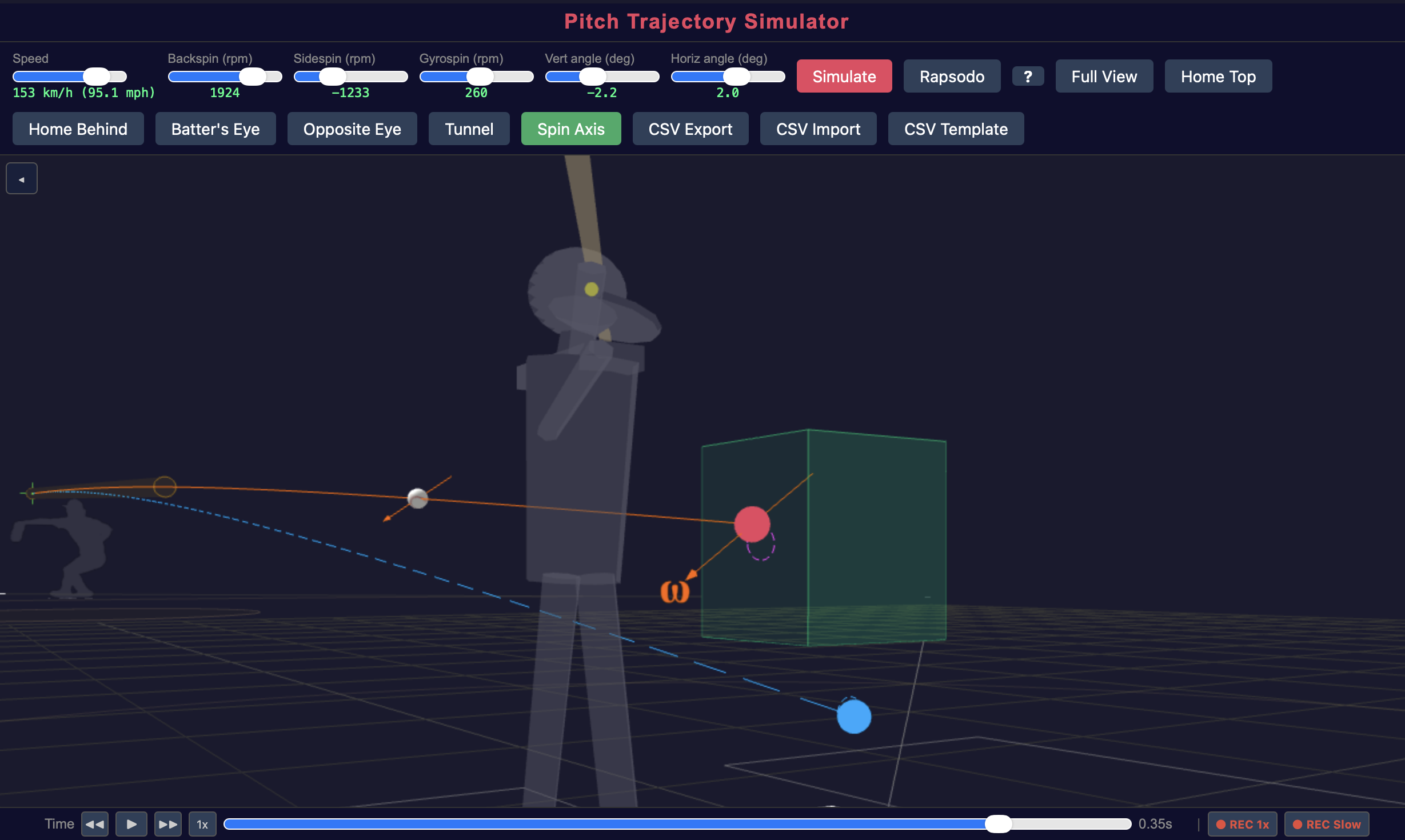
The animated baseball in the simulator rotates at the actual angular velocity of the pitch. An arrow attached to the ball shows the spin axis:
- Arrow pointing up → mostly backspin (four-seamer)
- Arrow pointing sideways → mostly sidespin (slider)
- Arrow pointing forward → mostly gyrospin (gyro slider, bullet spin)
Spin Efficiency
Spin efficiency is simply:
Spin efficiency = active spin / total spin
where active spin = backspin + sidespin (the components that actually move the ball).
A four-seam fastball typically has 90–100% spin efficiency. A gyro slider might have 30–50% spin efficiency — it spins fast, but much of that spin is “wasted” as gyrospin.
The spin axis is described in the Nathan model by three components: Backspin, Sidespin, and Gyrospin (BSG decomposition).
Given the angular velocity vector \((\omega_x, \omega_y, \omega_z)\) and the velocity direction, the BSG components are obtained by decomposing \(\omega\) relative to the velocity vector:
- G (gyrospin): component of \(\omega\) along the velocity direction
- B (backspin): horizontal component perpendicular to velocity
- S (sidespin): remaining component
Note: The B and S axes are always perpendicular to each other, but neither is exactly perpendicular to G. The BSG coordinate system is an oblique basis, not an orthogonal one.
The Magnus force depends on the lift coefficient \(C_L\), which is a function of the spin factor \(S = r\omega_T / v\).
The simulator supports two models:
Nathan (2020) exponential model (default): \[C_L = 0.336\,[1 - e^{-6.041\,S}]\]
This is a fit to combined wind-tunnel and motion-capture experimental data (Nathan, Am. J. Phys., 2008; updated 2020). It saturates at \(C_L \approx 0.336\) for high spin factors.
Rational function model (legacy): \[C_L = \frac{c_2 \, S}{0.583 + 2.333\,S}\]
where \(c_2 = 1.045\) (Statcast-fitted) or \(c_2 = 1.12\) (Nathan’s original Excel value). This model approaches \(c_2 / 2.333 \approx 0.45\text{--}0.48\) at high spin, which exceeds the experimental data.
For typical MLB pitches (\(S \approx 0.1\text{--}0.45\)), the two models give similar results. The difference becomes significant for high-spin pitches (\(S > 0.5\)), where the exponential model better tracks the experimental saturation.
Statcast provides the total spin rate \(\omega\) (from Trackman/Hawk-Eye) but not the breakdown into transverse and gyro components. The simulator estimates the transverse spin \(\omega_T\) from the trajectory data using one of two methods:
PFX method (default): Uses the measured pitch deflection (pfx_x, pfx_z) to estimate the Magnus acceleration as \(a_M = 2\,|\text{pfx}| / t^2\), then inverts the \(C_L(S)\) model to find \(\omega_T\). The transverse spin direction is estimated in 2D as \(\theta_\text{eff} = \text{atan2}(\text{pfx}_x, -\text{pfx}_z)\).
Acceleration method (Nathan 2020): Uses the Statcast acceleration components (ax, ay, az) directly:
- Remove gravity: \(\vec{a}^* = \vec{a} - \vec{g}\)
- Remove drag by projecting along the mean velocity: \(\vec{a}_D = (\vec{a}^* \cdot \langle\hat{v}\rangle)\,\langle\hat{v}\rangle\)
- Magnus acceleration: \(\vec{a}_M = \vec{a}^* - \vec{a}_D\)
- Transverse spin direction via 3D cross product: \(\hat{\omega}_T = \langle\hat{v}\rangle \times \hat{a}_M\)
The acceleration method provides more rigorous drag–Magnus separation and a full 3D spin axis estimate, but both methods give the same result when the CL model is consistent between estimation and simulation.
Reference: A. M. Nathan, “Determining the 3D Spin Axis from Statcast Data” (2015, updated 2020).